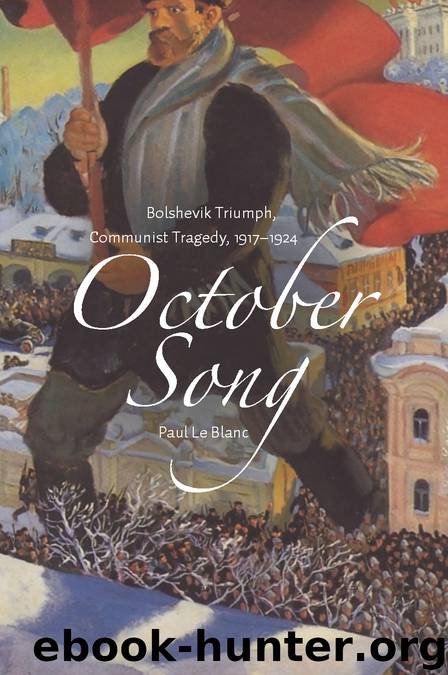
October Song by Paul Le Blanc
Author:Paul Le Blanc
Language: eng
Format: epub
Publisher: Haymarket Books
Published: 2017-11-03T04:00:00+00:00
7
Majority of the People
Historically, there had been a decades-long controversy among Russian revolutionaries over how the overthrow of tsarism and how the movement toward socialism might be accomplished. From the late 1880s down to 1917 and beyond, the two basic positions to emerge were that of the “populists” and that of the Marxists—the first positing a revolution based on the vast peasantry (in some cases assuming that capitalism could be bypassed altogether), the second positing a revolution based on the rising working class (in all cases insisting that capitalism was already and inevitably triumphing in Russia).1
In what follows, I will try to do justice to different lines of argument (each of which grasps aspects of the complex reality), but for the sake of clarity, I will state here that my own view tilts in the direction of Marxists who embrace Socialist Revolutionary insights.
Among Russia’s revolutionary Marxists, Lenin arguably developed the most insightful and the shrewdest approach to “the peasant question.” Russian Marxists—guided by the central thrust of Marx’s own analysis—focused on the modern proletariat that arose within the dynamic development of industrial capitalism. Lenin was no exception, and until 1917 he shared the general conviction that industrially backward, overwhelmingly agricultural Russia would first have to experience a thoroughgoing bourgeois-democratic revolution that would sweep away the authoritarian tsarist system of semi-feudalism/semi-capitalism—allowing for the full development of industrial capitalism and a bourgeois-democratic polity within which a dramatically expanding proletariat could both become the majority of the people and wage the ultimately triumphant struggle to “win the battle of democracy” (as the Communist Manifesto had put it).
Yet Lenin seems to have had a keener sense than many of the limitations and unreliability of the Russian bourgeoisie. More important, he had a keener appreciation of the combined oppression and revolutionary potential of the Russian peasantry. In contrast to his mentor George Plekhanov and other comrades who became Mensheviks, Lenin and (largely thanks to him) his Bolshevik comrades were able to develop a more radical, consistent, and uncompromising approach to the bourgeois-democratic revolution that was based on the central strategic conception of a worker-peasant alliance.
It can be argued that as a consistent Marxist, Lenin also had a decisive edge over the revolutionary populists of the Socialist Revolutionary Party, who were influenced by Marxism, to be sure, but maintained a critical distance from the Marxist mainstream that traditionally gave short shrift to the peasants. The nature of the working class was in important ways qualitatively different from that of the peasantry. The working class was concentrated more compactly than the peasants in a collective labor process, often within an industrial capitalist workplace, and these new proletarian layers were stimulated to think critically of their often new and dynamically changing surroundings. Increasing numbers of workers were becoming literate and in many cases were experiencing a growing scientific awareness, at the same time enduring what was increasingly and obviously the oppressive exploitation of their labor-power from which actual labor was squeezed in order to enrich their employers.
Download
This site does not store any files on its server. We only index and link to content provided by other sites. Please contact the content providers to delete copyright contents if any and email us, we'll remove relevant links or contents immediately.
| Anthropology | Archaeology |
| Philosophy | Politics & Government |
| Social Sciences | Sociology |
| Women's Studies |
The Secret History by Donna Tartt(19103)
The Social Justice Warrior Handbook by Lisa De Pasquale(12197)
Thirteen Reasons Why by Jay Asher(8919)
This Is How You Lose Her by Junot Diaz(6894)
Weapons of Math Destruction by Cathy O'Neil(6284)
Zero to One by Peter Thiel(5808)
Beartown by Fredrik Backman(5767)
The Myth of the Strong Leader by Archie Brown(5513)
The Fire Next Time by James Baldwin(5454)
How Democracies Die by Steven Levitsky & Daniel Ziblatt(5225)
Promise Me, Dad by Joe Biden(5157)
Stone's Rules by Roger Stone(5091)
A Higher Loyalty: Truth, Lies, and Leadership by James Comey(4966)
100 Deadly Skills by Clint Emerson(4931)
Rise and Kill First by Ronen Bergman(4797)
Secrecy World by Jake Bernstein(4756)
The David Icke Guide to the Global Conspiracy (and how to end it) by David Icke(4723)
The Farm by Tom Rob Smith(4517)
The Doomsday Machine by Daniel Ellsberg(4493)
